

Pedal Shift Lever
Description
Forged Aluminum Rear Brake Pedal: Lever with Integrated Serrated Foot Pad
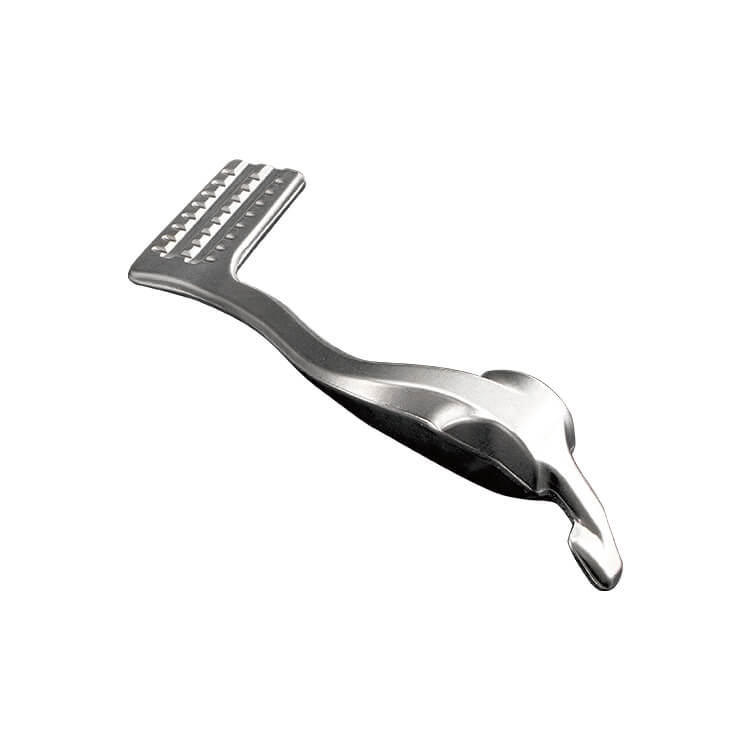
The forged aluminum rear brake pedal is the rear brake lever of a powersport vehicle, made up of a foot pad with anti-slip serrations, a curved lever arm and a pivot boss with link arm at the rear. The rider operates the rear brake with the foot, so the lever must withstand pedal force and accidental impacts in off-road and muddy conditions.
Al Forge Tech (AFT) closed-die hot forges the pad, serrations, arm and pivot boss in one operation, with grain flow continuous along the curved arm, avoiding the weak points of multi-part welded assemblies. After heat treatment, the pivot and link holes are CNC-machined, and the lever can be anodized or shot-blasted for corrosion resistance and appearance.
Key Features
- Serrated foot pad, arm and pivot boss forged in one piece
- Continuous grain flow along the curved arm for pedal and impact loads
- Pivot and link holes CNC-machined
- Anodizing or shot blasting for corrosion resistance
Forged Aluminum Rear Brake Pedal Specifications and Manufacturing Capability
| Item | Details |
|---|---|
| Product category | Aluminum Forging Moto Parts |
| Application | Rear brake operation on ATVs, powersport vehicles and motorcycles |
| Primary process | Closed-die hot forging (hot forging presses 600T–8,000T) |
| Material | Per customer specification; heavy-motorcycle parts produced in grades such as 6061-T6, 2014-T6 and 7075-T6 |
| Heat treatment | In-house T4 solution treatment (8 units) and T6 artificial aging (7 units), set by alloy and strength requirement |
| Secondary machining | CNC machining (52 machining centers, 30 lathes), deburring, vibratory finishing |
| Surface finish | Anodizing (including hard anodizing), shot blasting, e-coating or painting, as required |
| Inspection | Zeiss CMM (4 units), hardness testers, spectrometer, fluorescent penetrant inspection line |
| Dimensions and tolerances | Per customer 2D/3D drawings |
| Quality system | IATF 16949:2016, ISO 14001:2015 |
Forged Aluminum Rear Brake Pedal Manufacturing Process
- Drawing review and DFM: we confirm alloy, load direction and critical dimensions, then run QForm simulation to predict metal flow and defect risk.
- Die design and manufacturing: the number of die sets (for example, blocker and finisher dies) is planned around part complexity, and die contours are checked with a portable 3D scanner.
- Hot forging: closed-die forming on 600T–8,000T hot forging presses creates a continuous grain flow that follows the part contour.
- Heat treatment: T4 solution treatment and T6 artificial aging are performed in-house, with parameters set by alloy and strength requirement.
- CNC machining and finishing: holes, threads and mating surfaces are machined, followed by deburring, vibratory finishing, shot blasting or anodizing as required.
- Inspection and shipment: dimensions, hardness and chemical composition are verified with CMM, hardness testers and a spectrometer, with lot traceability kept under IATF 16949.
FAQ
Are the anti-slip serrations on the pad forged?
Yes. The serrations can be built into the forging die and formed together with the pad, keeping their shape consistent in production and saving milling time. If sharper edges are needed, they can be locally CNC-finished after forging. AFT assesses forging feasibility for the serration size at the DFM stage.
How does an off-road brake pedal balance strength and weight?
An off-road pedal must withstand pedal force and impacts from rocks or rollovers. AFT forges the lever so grain flow follows the curved arm, and selects the alloy and T6 conditions to customer specification to balance strength and weight. The arm section can be adjusted to the load direction at the DFM stage to remove unnecessary material.
How does a forged aluminum Forged Aluminum Rear Brake Pedal compare with casting or machining from billet?
Forging shapes aluminum in the solid state under pressure, so the grain flow follows the part contour and the porosity and shrinkage common in castings are avoided. Compared with machining from solid billet, a near-net-shape forging removes less material and shortens machining time. For a Forged Aluminum Rear Brake Pedal under repeated loads, forging balances strength and weight; the final choice still depends on design loads and volume.
Is heat treatment for the Forged Aluminum Rear Brake Pedal done in-house?
Yes. Al Forge Tech operates 8 T4 solution treatment units and 7 T6 artificial aging units on site, so the Forged Aluminum Rear Brake Pedal can be solution treated, quenched and aged in the same facility before machining and inspection. Keeping heat treatment in-house removes inter-plant transport, reduces lead-time risk and keeps lot traceability within one quality system. Parameters are set according to the alloy grade and your specification.
Can the Forged Aluminum Rear Brake Pedal be anodized or given other surface finishes?
Yes. Al Forge Tech offers anodizing (including hard anodizing), shot blasting, vibratory finishing, e-coating and painting, plus pickling and ultrasonic washing lines to clean parts after machining. Please note the finish type and film thickness on the drawing so machining allowances and cosmetic standards for the Forged Aluminum Rear Brake Pedal can be evaluated together.
Request a Quote for the Forged Aluminum Rear Brake Pedal
Developing a new Forged Aluminum Rear Brake Pedal or converting an existing part to aluminum forging? Send us your 3D/2D drawings, alloy and temper, annual volume and finishing requirements. Our engineering team will reply with a feasibility review, die plan and quotation.
- Online inquiry: Contact Us
- Email: [email protected]
To compare similar parts, browse Aluminum Forging Moto Parts and our automotive aluminum forging applications, or visit About Us for our equipment and certifications.
