

Steer Tube
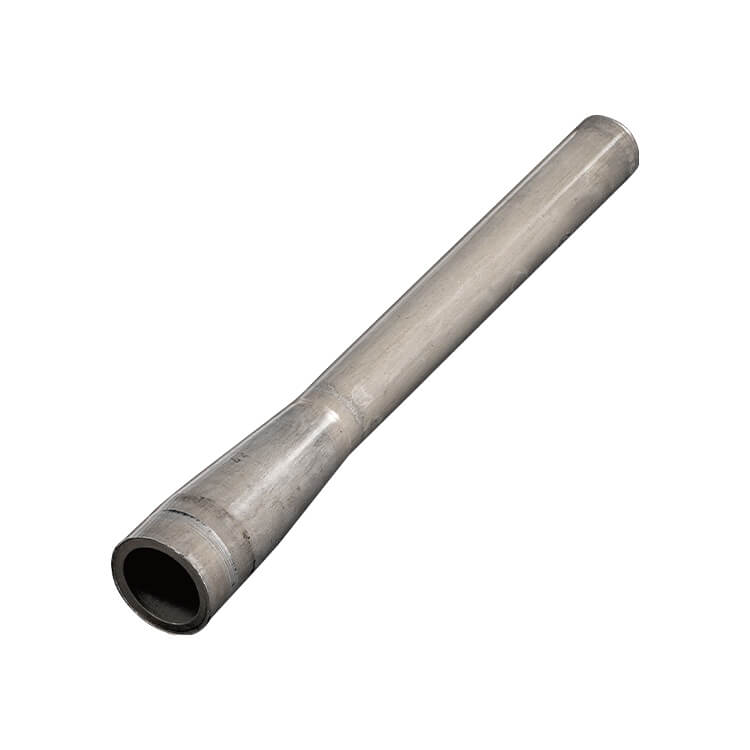
Aluminum Bicycle Steerer Tube: Variable-Diameter Fork Steerer
The aluminum bicycle steerer tube is the steering column of a fork. Its upper end passes through the frame’s head tube and is clamped by the stem, while its lower end joins the fork crown. This version is a long slender tube with a change in outer diameter and a thickened lower section for press-fitting or joining to the crown and for carrying bending loads from steering and braking; variable-diameter designs are also common in tapered head tube systems with different upper and lower bearing sizes.
The joint between steerer and crown sees the highest bending stress and needs a thicker wall, while the upper section can use a thinner wall to save weight. Al Forge Tech (AFT) evaluates cold forming for the diameter change and wall thickness, finish-turns the outer diameter and joint section, and inspects diameter, roundness and straightness on CMM. Anodizing is available.
Key Features
- Thickened, stepped lower section strengthens the crown joint
- Thin-wall upper section saves weight
- OD, roundness and straightness finish-turned and measured
- Can be developed together with the triple clamp
Aluminum Bicycle Steerer Tube Specifications and Manufacturing Capability
| Item | Details |
|---|---|
| Product category | Aluminum Forging Bicycle Parts |
| Application | Fork steerer tubes for bicycles and e-bikes |
| Primary process | Cold forming (cold forging presses 260T–2,500T), evaluated by diameter change and wall thickness |
| Material | Selected to customer specification; 2xxx, 5xxx, 6xxx and 7xxx series aluminum alloys available (e.g. 2014, 6061, 6082, 7075) |
| Heat treatment | In-house T4 solution treatment (8 units) and T6 artificial aging (7 units), set by alloy and strength requirement |
| Secondary machining | CNC machining (52 machining centers, 30 lathes), deburring, vibratory finishing |
| Surface finish | Anodizing (including hard anodizing), shot blasting, e-coating or painting, as required |
| Inspection | Zeiss CMM (4 units), hardness testers, spectrometer, fluorescent penetrant inspection line |
| Dimensions and tolerances | Per customer 2D/3D drawings |
| Quality system | IATF 16949:2016, ISO 14001:2015 |
Aluminum Bicycle Steerer Tube Manufacturing Process
- Drawing review and DFM: we confirm alloy, load direction and critical dimensions, then run QForm simulation to predict metal flow and defect risk.
- Die design and manufacturing: the number of die sets (for example, blocker and finisher dies) is planned around part complexity, and die contours are checked with a portable 3D scanner.
- Cold forging: cold forming on 260T–2,500T presses, suited to thin-walled, tubular and dimensionally repeatable parts.
- Heat treatment: T4 solution treatment and T6 artificial aging are performed in-house, with parameters set by alloy and strength requirement.
- CNC machining and finishing: holes, threads and mating surfaces are machined, followed by deburring, vibratory finishing, shot blasting or anodizing as required.
- Inspection and shipment: dimensions, hardness and chemical composition are verified with CMM, hardness testers and a spectrometer, with lot traceability kept under IATF 16949.
