

Industrial Hardware-3
Description
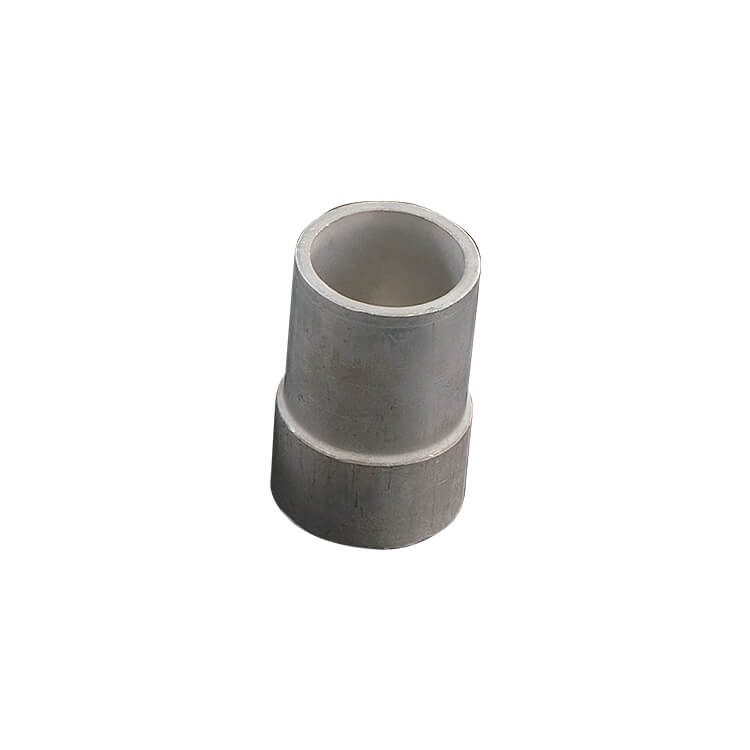
Industrial Hardware F-12 is a forged aluminum sleeve with a stepped outer diameter: a smaller-diameter upper section, a larger-diameter lower section and a through bore. The step acts as an axial locating shoulder during assembly, making this geometry common in guide sleeves, spacers, bearing locating rings and mechanism connectors.
Turning a stepped sleeve from solid bar removes a large volume of material to create both the bore and the two diameters. Forging the hollow and stepped profile first reduces scrap and shortens turning time. Al Forge Tech (AFT) evaluates cold or hot forging by wall thickness and length, then finish-turns the bore, outer diameters and shoulder in-house and verifies concentricity on CMM.
Key Features
- Two outer diameters and bore forged to near-net shape, cutting material waste
- Locating shoulder turned to assembly tolerance
- Suited to batch parts such as guide sleeves and spacers
- Anodizing or hard anodizing available
Industrial Hardware F-12 Specifications and Manufacturing Capability
| Item | Details |
|---|---|
| Product category | Aluminum Forging Industrial Hardware |
| Product No. | F-12 |
| Application | Guide sleeves, spacers, bearing locating rings, mechanism connectors |
| Primary process | Hot or cold forging, selected by geometry, wall thickness and volume (hot 600T–8,000T / cold 260T–2,500T) |
| Material | Selected to customer specification; 2xxx, 5xxx, 6xxx and 7xxx series aluminum alloys available (e.g. 2014, 6061, 6082, 7075) |
| Heat treatment | In-house T4 solution treatment (8 units) and T6 artificial aging (7 units), set by alloy and strength requirement |
| Secondary machining | CNC machining (52 machining centers, 30 lathes), deburring, vibratory finishing |
| Surface finish | Anodizing (including hard anodizing), shot blasting, e-coating or painting, as required |
| Inspection | Zeiss CMM (4 units), hardness testers, spectrometer, fluorescent penetrant inspection line |
| Dimensions and tolerances | Per customer 2D/3D drawings |
| Quality system | IATF 16949:2016, ISO 14001:2015 |
Industrial Hardware F-12 Manufacturing Process
- Drawing review and DFM: we confirm alloy, load direction and critical dimensions, then run QForm simulation to predict metal flow and defect risk.
- Die design and manufacturing: the number of die sets (for example, blocker and finisher dies) is planned around part complexity, and die contours are checked with a portable 3D scanner.
- Cold forging: cold forming on 260T–2,500T presses, suited to thin-walled, tubular and dimensionally repeatable parts.
- Heat treatment: T4 solution treatment and T6 artificial aging are performed in-house, with parameters set by alloy and strength requirement.
- CNC machining and finishing: holes, threads and mating surfaces are machined, followed by deburring, vibratory finishing, shot blasting or anodizing as required.
- Inspection and shipment: dimensions, hardness and chemical composition are verified with CMM, hardness testers and a spectrometer, with lot traceability kept under IATF 16949.
FAQ
How does the F-12 differ from the F-11?
The F-11 is a sleeve with an external flange, where the flange face is used for clamping and axial location. The F-12 is a stepped sleeve that locates on a shoulder and is closer to a straight cylinder, suited to applications where the part is inserted into a bore and seated on its step. Both can be adapted to your drawing and alloy; the choice depends on assembly method and load direction.
How is concentricity controlled on a stepped sleeve?
Concentricity is controlled mainly at the turning stage. AFT leaves an even machining allowance on the forging and turns the bore and both diameters in a single clamping to avoid re-chucking errors. Concentricity and runout are then measured on Zeiss CMM, with records kept under IATF 16949 for lot traceability.
Can Al Forge Tech supply the Industrial Hardware F-12 from forging through machining?
Yes. Forging, heat treatment, CNC machining, surface finishing and inspection are integrated in one facility: 52 CNC machining centers (40 four-axis and 12 4.5-axis), 30 lathes (14 with robotic loading), plus broaching, burnishing and centerless grinding. The Industrial Hardware F-12 can be delivered as a forged blank, semi-finished or fully machined part.
Can you assess forging feasibility while the Industrial Hardware F-12 is still in design?
Yes. Al Forge Tech works mainly as an OEM supplier, and our engineers can give design-for-manufacturability (DFM) feedback at the concept or drawing stage, such as adjusting thin ribs, abrupt section changes or draft angles to avoid laps and underfill. QForm simulation predicts metal flow early, and the results are cross-checked against our die design experience.
How are MOQ and lead time for the Industrial Hardware F-12 determined?
MOQ and lead time depend on part size, number of die sets, alloy and machining scope, and are confirmed in the quotation after drawing review. The typical sequence is die development, forged samples, sample approval and then mass production. Sharing your annual volume and call-off schedule helps us plan dies and capacity for the Industrial Hardware F-12.
Request a Quote for the Industrial Hardware F-12
Developing a new Industrial Hardware F-12 or converting an existing part to aluminum forging? Send us your 3D/2D drawings, alloy and temper, annual volume and finishing requirements. Our engineering team will reply with a feasibility review, die plan and quotation.
- Online inquiry: Contact Us
- Email: [email protected]
To compare similar parts, browse Aluminum Forging Industrial Hardware and our industrial hardware forging applications, or visit About Us for our equipment and certifications.
